Thursday, February 19, 2015

Lent: Adding Habits


Lent...time to give up (not on yourself or people)...or give...or do extra. Traditionally, growing up, we always found something to give up.  As a kid, you might have been one to give up something easy. I remember Mom giving up Coke which is something she definitely enjoys. In college, I gave up dessert every year. It was very hard for me, but by the end I was proud of the discipline I had learned which taught me to withhold gratification or just wait. I also felt like it brought me closer to the Lord. Not that I learned exactly what he went through for mankind, but it encouraged me to think about what he gave up for us. I think sacrifice does give us an appreciation for what we have and also helps us to put ourselves in the shoes of others. Giving up meet on Fridays also reminds me that I am fortunate enough to be able to by good tasty meat and that it is important for me to take a day to eat something like fish that has health benefits.

Several years ago, I started something different for myself instead of "giving up" by "doing different" or changing habits and I found that many others were also "doing" this too. Giving up desserts, like I mentioned, helped me in a lot of ways, but I also went back to eating desserts regularly after lent too. I wanted to do something to change habits that I wanted to continue all year. Last year I focused on my response with tone of voice in moments of frustration. It's something I was trying to do anyway, but being lent, I had the extra reminder. I have another friend who a few years ago, decided she was going to go to bed earlier. She picked a time that she had to be in bed by which I think was 11:00 PM. She said it helped her to feel more refreshed in the morning although some nights she was practically running to hop in bed on time from whatever she was doing, but 40 days of it was good for helping to change a habit. 

This year I decided I am going to write in a journal every night.  A paper journal with a pen.  It doesn't have to be lengthy, but I'm going to write something about what I'm thinking, feeling, enjoying, or just something that happened in the day. I did this very frequently in college and it was very emotionally refreshing.  Sometimes issues that were bothering me seemed more clear after writing them down. I think that journaling every night may help me to be more patient in my family life, more relaxed, and feel like my mind is not racing.  Journaling in a computer is good too, but it feels different when writing with a pen and paper.  I have learned that different neural pathways in our brain are used with writing rather than typing.  It requires us to make "shapes" or "lines" when we write and not just push something.  It requires a bit more artistic side plus more.  There is some sacrifice involved with this too. I will have to sacrifice time to do this, but I think during and after, I will be glad. So this will be my extra. 

Just to add a little story to this lent post, I recently went to confession and was impressed by the penance the priest gave me.  He put the penance on me and said, "What do you think you should do to fix it?"  He gave advice, but also gave me some independence in solving the problem which I think is what great counselors do.  I told him I needed to make a plan on what I would do in that situation the next time. He said, "Okay good. That is your penance."  I appreciated his help in working to change habits. 


Friday, February 6, 2015

Exploring Sounds- Auditory Skills


This week at home, for pre-school, I thought an exciting theme for discovery would be Exploring Sounds. There are a variety of auditory skills that are important to develop and can be learned and practiced through numerous enjoyable games. I use these games during music therapy evaluations to get an idea of any auditory sensory issues that might be going on with my students. 

Audition is the physical act of hearing or receiving sound).  It is passive and involuntary.  The ear is the transmission system and sends the information to the brain in a few areas including the auditory cortex and the pre-frontal lobe. The brain is "suppose to discard un-needed auditory information after evaluating its safety and informational features (Berger, 87).  The way we receive and process sound of course affects the way we receive and express language. 

The games we played this week include 

  • auditory discrimination 
  • sound localization
  • depth perception

Auditory discrimination is needed to tell the difference between sounds.  We can determine with this skill that language sounds are different than other sound effects like animals and machinery. We can also tell the difference between letter sounds like an "F" sound and an "S" sound. Sound localization is determining where a sound is coming from and depth perception tells us how far away or close it is. The absence of this skill can be a safety problem in situations like crossing a street. 

Auditory Discrimination

Game Number 1
I placed 4 different sounding instruments on the floor on one side of a wall where I was sitting. On the other side of the wall I placed the exact same instruments where my daughter sat. I sang a tune which I got from my supervisor with instructions to listen and then play what is heard.  The instruments included a drum, a maraca, a tambourine, and rhythm sticks. 


After she was successful at determining which instruments I was playing by listening I gave her a few more instruments to choose from.  These instruments required listening a little closer due to some of the new instruments sounding more similar to others such as the claves vs. the rhythm sticks and the tambourine vs. the bells.  With practice she was able to learn these too. 


Game Number 2
We also played a very simple auditory discrimination game by having her listen to sound effects I found on Spotify and having her guess what they were.  Some examples included birds, a fire truck, the ocean, etc. 


Sound Localization and Depth Perception
In this game I used my Bluetooth speakers and the music on my phone to play Music Hide and Seek. I hid the speakers while my daughter hid her eyes. When it was hidden I hit "play" on my phone and music played from the speakers.  She followed the sound to where she thought she heard it coming from, determining the direction (sound localization) and how far away it was (depth-perception). She took turns having me find it too. Even though she found it every time, she still asked me how I knew where it was. :) 


There are many other skills we did not do that include

  • Auditory figure-ground- what we hear in the foreground while putting non-important sounds in the background. 
  • Auditory focus- What one choose to listen to in a soundscape
  • blending of sounds-putting sounds together to form words and sentences.
  • Auditory tracking- The brain following and keeping track of a sequence of sounds.


Berger, D.S. (2002).  Music Therapy, Sensory Integration, and the Autistic Child.  Routledge.

Sunday, January 4, 2015

Ocean Drum Experience

Group Ocean Drum 

This video was taken by an occupational therapist who provides music experiences for a variety of children in the SA area.  Here he has them sharing an ocean drum and working as a team to get the balls to go around.  This is a great activity for improving the auditory system while using it to take part in team work of making the smooth ocean sounds.  Background music could also be added to help them keep the balls moving to the beat.  Depending on the needs of the clients, upbeat music could be used, as well as music that helps to calm.  This can be a great outlet for stress.

Great for auditory and social skills, calming, and tactile input.

Thursday, December 11, 2014

Annual Baptism Celebrations


Happy Baptism Day! This day does not quite have the hype of turning a new age and celebrating a birthday, but the kids can have a great time celebrating a new year as a member of our church family and find it exciting too.  We have been evolving our celebration over the past few years that we started making sure that we celebrate their special baptism anniversary.

I really want them to know that this day is a big day.  I started by making sure we mention the date of their baptism often to help them learn it, and we do special things on that day.  Both of my children's baptisms happen to be during the summer which makes it easy for us to do a special breakfast for them. We make it special  by using the nice place mats and put out a few decorations, etc.  We also light their baptism candle during the breakfast and put out there baptismal framed photo and photo album of the day. They enjoy looking through it during breakfast. And of course we say special prayers asking for blessings over them and remind them that the sign of the cross reminds us of our baptism. We finish up with reminding them that one day they will make their confirmation and continue the "yes" that we said for them if they choose to. 

Enjoy your baptism day!


Dropping Paper...Ever Have the Urge?


Dropping paper and cards on the ground does not happen to be my urge personally, but it does happen to be something one of my students finds greatly interesting.  In fact, it is something he will walk off and do any time he feels he needs to or wants to. Yes, this student does have autism.  When I first started doing an evaluation with him, I was searching for ways through music to keep him distracted from the things he desired or felt he needed to do.  The team was searching for ways to keep him engaged so he could get his school work done.

In the middle of the evaluation process (which takes a few weeks), I was asked to read the book titled, The Reason I Jump, by Naoki Higashida, a boy with autism. I believe he was about 13 when he wrote it (and when I say write, I mean he had someone help him get the words out that he wanted to say in a much different way than we would write).   Even though I was aware of the sensory differences in all sensory systems that those with autism experience, this boy changed the way I approached my techniques. I realized that many times, they cannot control the urges they have to do different things and sometimes cannot even realize what their limbs are doing.

Naoki explained how much detail they see in objects upon first sight.  For many of us, we see the object as a whole and then begin to notice details over time.  This gave me ideas about my own student.  If I have to guess, I would say he processes visual sensory information much differently than I. He sees something I do not see, constantly looking towards the ceiling with his hand moving slowly in front of his face.  He has a great fascination with airplanes and things moving through the air, hence, the dropping paper and cards and watching them fall to the ground.

Well, I had completed all of my observations and information gathering. I was now on the third day of assessing his IEP objectives WITH music and comparing them to how he did WITHOUT music. It had served well as a memory and information recall tool for this boy, but it was not keeping him focused and less distracted from any stimulation urges he had.  The music was not motivating him and motivation to work with music is usually the first sign that music therapy would be a good therapy for a student, and we were down to one more objective of learning his phone number. He is great at matching pictures, letters, and numbers which is what we were having him do to the melody I was singing, but he had no interest whatsoever to leave his ceiling gazing and paper dropping.  

The teacher and I sat for a minute both of us thinking.  Think outside the box...think outside the box...nothing in the box has been successful...what message would Naoki be giving to me here?  Well of course. An idea came.  Stop fighting the urge....use them in the objective. I tossed some of the numbers he used to match his phone number on the floor with some of the extra numbers that he didn't need. I saved some for him too and made sure he noticed when I tossed them on the floor.  "Here, your turn," I told him.  He took some and let them fall to the floor.  On his face we could see signs of pleasure.  "Find the number 2 like this!" I showed him and then sang the melody.  And he found it and placed it in the correct spot. Oh thank heavens. It took a few more drops to the floor with the numbers, but we managed to get the phone number matched and in addition were able to get him to recall the numbers afterward through the melody. Success? I definitely felt like it was.

He received music therapy services following, because of how well it worked as a memory tool and conveyor of information. Another yay for music. Keep the music in you!

Thursday, November 20, 2014

Suggestions to Try at Home to Stimulate Speech Using Music

While I am still working towards getting some music videos of ways to use speech and music up here, I thought I should go ahead and just post a list of common suggestions I give to parents to try and stimulate and improve speech at home.

The great thing about music therapy is that when the client's are engaged in the music, they often forget that they are doing work! The brain cannot process information when it is stressed, so music can be a stress reducer and allow the brain to take in more information. Between pitch, rhythm, and lyrics, their are constantly new ways to explore music and create new experiences.  Clients also have an opportunity to try new things and they are set up for success in creating their own music or inputting their own ideas. In addition, music is providing alternate neuro pathways in learning. 

I am not a speech pathologist. I do work with them in my job in the schools.  I do know that speech is complicated. Our brain is very busy when we listen to speech and say it ourselves. In order to process one word like "hello," our brain has to:

  1.  "catch" all of the sounds (h, e, l, oh) 
  2. learn each sound, 
  3. learn how to recreate each sound, 
  4. put them in order
  5. store them in memory
  6. know the meaning behind the word (hello is a greeting you say when you see someone)


Here are a few ways to try music at home to encourage speech using music.


Last Lyric
Sing familiar songs and have the child fill in the last word of a line.  The last word of a line is often a point in the music that compels a person to sing/hum the last pitch.  A very basic example is, "Row row row your boat gently down the _______.  Merrily merrily merrily merrily life is but a _______."  It feels very strange to leave off the last word. 

Vowel Singing
Pick a vowel sound and sing it to a familiar tune.  I often use Little Bitty Pretty One.  Oh oh oh oh oh or ah ah ah ah ah. 

Syllable Singing
Pick a sound or syllable to practice such as "ba," "do," or "me" and sing it to a familiar tune instead of the lyrics.  ba ba ba ba ba ba ba ba ba baaaa.
This is much easier on our auditory tracking. Our brain has time to "catch" the sound being heard and learn the sound because it's only two sounds rather than the large number of sounds that fill up a sentence.  For instance, "Row row row your boat gently down the stream" has about 19 different sounds that the brain has to sequence and put in order after catching each one.  In the word "row," it catches the "r" sound and the "ow" sound and puts it in order. Our brains do a lot of work to make a sentence! 

Sound Sequence
Sequence 2 or 3 sound together (after mastering example 3) and sing it to a familiar tune.  For example, "ba bee ba bee ba bee."    When that is mastered change the consonant in the second syllable, but use the same vowel again (ba da ba da ba da).  The next step may be to do two different consonants and two different vowels (ba de ba de ba de).  

Tapping
Have opportunities to break up syllables in words by tapping them out.  I frequently use this for rate of speech.  One student I worked with had unintelligible speech because of articulation and also how fast she tried to fly through her words.  Having her tap out each syllable on her leg helped tremendously.  When I demonstrated tapping while I spoke, she was also able to better hear each sound of each syllable.  I highly recommend this for rate of speech and articulation.  Use drums, shakers, and other creative ways to make sounds.

Blowing Instruments
If breath support is an issue, try having the children try out recorders and then kazoos.  


Songs that have Repeated Syllables
Lemondrops and Gumdrops (ah, ah ah)
Little Bitty Pretty One
Menahmena (Sesame Street)
Down on Grandpa's Farm (animal sounds that echo)
Little Green Frog (Ah Ah said the little green frog)
Runaround Sue (hey)
Crocodile Rock (la...la la la la la)
Biddy Biddy (Music Together)
Stick Tune (Music Together)

More Advanced
Do Wah Diddy
Ooh EE Ooh Ah Ah
Trashin the Camp- Tarzan Soundtrack

Wednesday, October 29, 2014

Apple Pickin...in Texas


Our family just loves autumn...but really, who doesn't? We don't get near the beautiful changes in color of trees here in Texas but it's still a beautiful time of year. We also love the idea of picking our own fruits and veggies. Unfortunately we don't have our own apple tree or pumpkin patch. I tried pumpkins many years. We just don't have the space to give them adequate care.  We have picked our own apples when we visited friends in Washington and that was incredible.  There's not any farms to visit around here that I know of. Peaches in the summer, but no apples in the fall for the public. 

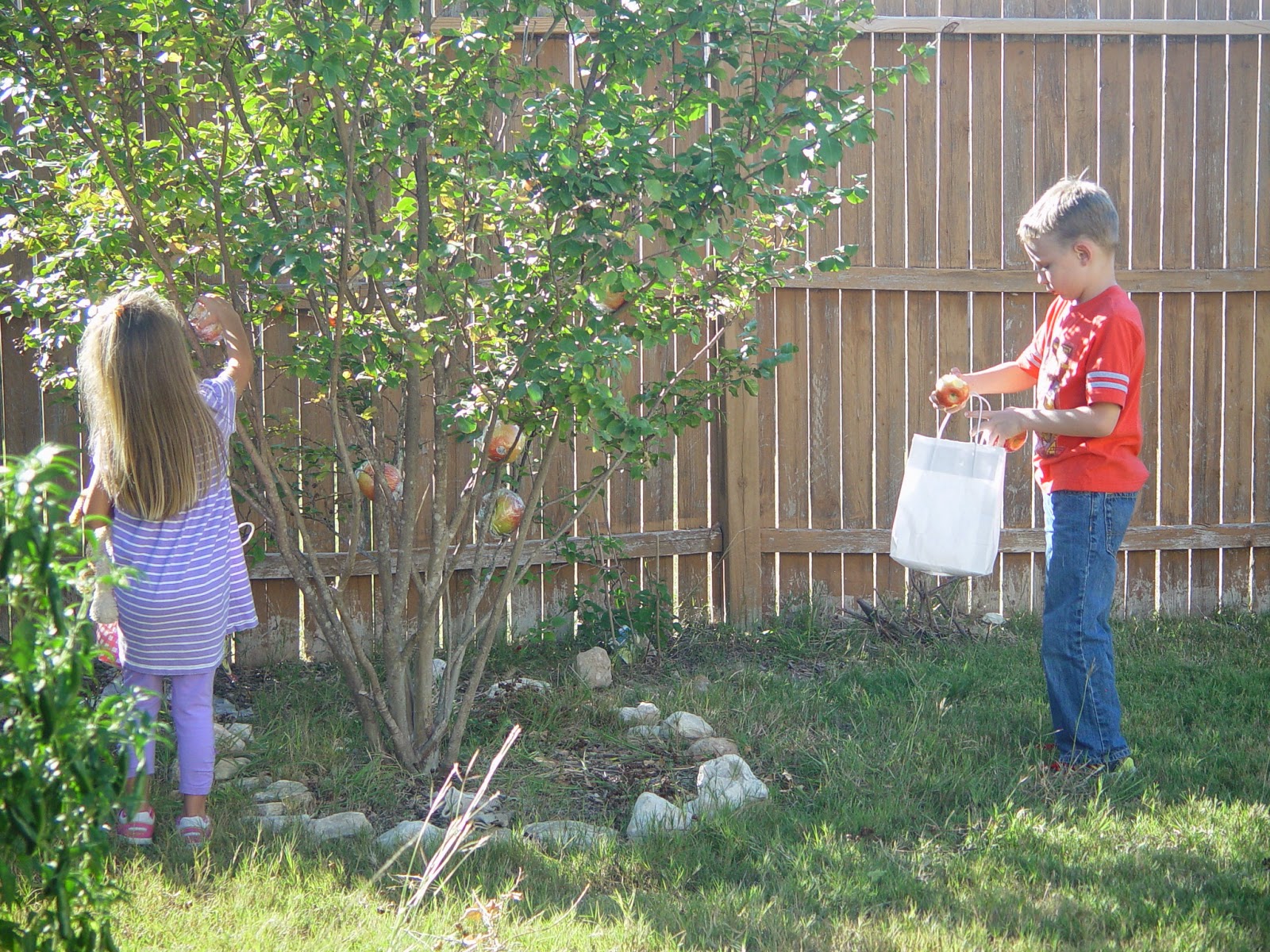
So this month, my kids expressed a great desire to pick apples.  I was really wanting to make their requests possible, but knew the only place we they could "pick" their own apples was at HEB and right off the shelf.  But I wanted them to have a fun fall apple experience and thought about how we could have fun with apples.  And it came to me. The kids know that we pretend Santa is real. We write pretend letters, we pretend that we are preparing for his visit, we leave out real cookies for the pretend Santa....so why not pick apples off of a "pretend" apple tree?

We have a Live Oak in the front yard and a Crepe Myrtle in the backyard.  Good enough for me. So here is what I did. 


I bought some nice looking apples that I "picked" myself at HEB and wrapped them individually so they would stay clean.

Looks okay, right? Pay no attention to that sticker. 

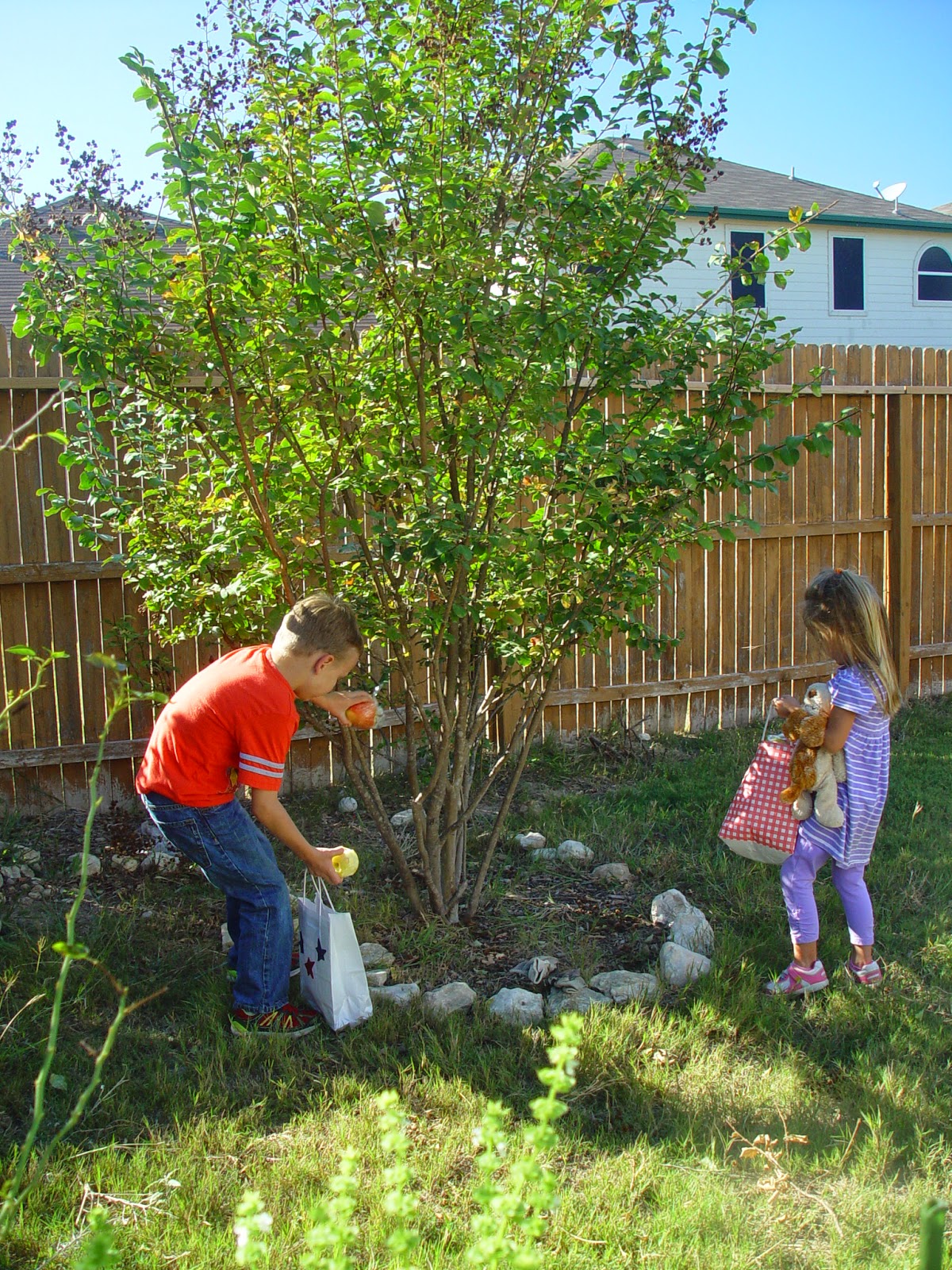
I placed them in the tree so that they would stay secure.  

And put a few low enough for Adelyn to reach.  They were pretty low when we picked real apples in Washington.

I then told them we were going apple picking, handed them bags, and led them out the front door and on a "hike" around our front yard to the backyard "orchard."  As soon as we got in sight of the tree they sprinted to start their picking.

They both loved it. My 4 AND 7 yr old.  They knew it was pretend, but pretending is fun!


Look at my apples!

Good thing I washed them before wrapping! Someone couldn't wait to chow down.


If we don't have access to the real thing, that is okay. We can still have provide great experiences in our own homes and backyards.  Imagination is fun, fosters creativity and path to further invention, and it gives hope. 

Here is the rest of our story.

Washing her apples!
Washing his apples!


Preparation for pie.  Apple tower. 3 apples up on top!

Peeling apples for our apple pie!

Pie before baking in the oven (with our neighbor friend).

They helped with the lattice work. Now it just needs to cook!  

It's done! We love pie. That was fun!


Blog Archive