Showing posts with label Parent Resources. Show all posts

Wednesday, March 23, 2016

Auditory Input Sensitivity Pros and Cons

Pairing auditory and visual input to calm Lincoln in the car

When our third child was born, I believed what people say about the third kid being a piece of cake and told myself that understanding the sleep milestones would set me up for even better success at teaching my child to sleep and that knowing so much more about sensory systems would help me set up an even better environment for his learning, play and comfort.

I still do think that the third time around, many many things are so much easier.  I was much less overwhelmed knowing about baby sleep and sensory systems as well as developmental milestones, diaper brands and sizes, pumping, when to start them on solids, how to identify acid reflux and food allergies, packing a diaper bag of some sort and so forth.  I was still in for a surprise when I realized in the hospital that our newborn son did not sleep the way I remembered my other two newborns who slept through anything.  In fact Adelyn, our second, was so incredibly hard to wake for feedings that we had every light in the room at full brightness, voices, music, and her down to the diaper.

Problem
Lincoln startled at the drop of a feather. Surely the next day he would sleep better.  Maybe it is just day one.  Was that how it was 5 1/2 years ago when Adelyn was born? As we continued throughout that day and the next I realized that it was not just day 1 and he did not stay asleep well either. Zachary didn't stay asleep well in the hospital either, but it was not due to sounds and startling like Lincoln.  When the nurse came in to do the hearing screening I said, "Oh he DEFINITELY hears." So the newborn sleep phase as I remember it, did not happen.  Lincoln went through the phase of staying asleep for long periods of time, but we were tiptoeing around him like we had a pack of sleeping wolves.

Sounds
He has grown used to many sounds in the environment we provide, especially our immediate family voices in a variety of emotions, but many sounds still startle or make him uncomfortable.  I know that most babies find the hair dryer and vaccuum distasteful so some of this is typical, but I find his sensitivity to be more extreme.  New discoveries of issues began to be uncovered about the time that he became 4 months old. He is not happy in a room of chattering mothers, especially when he is tired or hungry which makes moms meetings difficult to handle. One of the most recent discoveries is that Lincoln is not cool with other people expressing their emotion of laughter when something is funny if you are going to exceed his decibel level comfort.  In his opinion, if you are going to find something funny and laugh, you should probably retrain yourself or better yet stuff a sock in your cheek for the time being. It does not seem to be an issue for those of us he is used to being around.

I have determined to myself that Lincoln's auditory system is sensitive, but I believe it is due to having his defenses up against anyone or anything unfamiliar that could compromise his comfort or safety.  In other words, anxiety to the unknown. I think this because he has become used to the loud sounds that any of us in the immediate family make.  He watches our facial expressions when he hears the sounds and determines whether or not it is good or bad.  Zachary was not quite to the extreme that Lincoln is, but he also was a little sensitive and a little anxious as a baby.  It may just be something that Lincoln will grow out of.  Zac did and has overcome some anxiety with some assistance from us (he does still use headphones to mow the lawn like I do).

Pros
A pro to Lincoln being so aware of auditory input is that he is mesmerized when I sing to him.  During car rides of all lengths, especially the first 6 months, I spent a good deal of time singing to him. Sometimes it calmed him enough to get him to sleep.  But not always!!!! He finally, at 6 1/2 months learned to fall asleep in the car without assistance, praise the Lord!! Of course, there has been almost nothing consistent about his sleep except that for the first 5 months, he only stayed awake an hour to an hour and fifteen minutes between naps.  In the early months a Disney Lullaby Cd with arrangements by Fred Molin, worked at calming him in the car. For the most part, live, vocal singing by voices he recognizes has worked the best in calming him.

Car Ride Torture
The kids have joined in helping, especially on car rides.  On our Christmas trip, we spent about 45 minutes singing familiar tunes over and over to Lincoln during the first part of our journey.   Unfortunately, it seems that being strapped down to a seat in a moving object makes children angry and frustrated.  I thought we would never make it to my parents house in Houston and then my grandparents in Louisiana.  We had split the trip up in two days. I was absolutely DREADING the 7 hour trip getting home.  Scott took the train to meet us in Louisiana and as soon as I saw him, before "hello" and "how was your trip" I said, "I want to fly home when we leave next week.  Just me and Lincoln."  As it turned out, the 1 way ticket would be $600.  We were driving. Actually, we were riding. I sat next to Lincoln on the drive home. I patted the back of his car seat to lull him to sleep when it was time to sleep.

Paring Sound and Visuals
By the last couple of hours of the journey toys were not enough to keep him happy, nor were books and my beloved singing trick. Finally, I picked up a book which contained a song as lyrics and sang it to him while I showed the pictures.  He was enthralled.  Thank the Lord. I was spared. Why in the world had I not pieced this together? I mean after all that time studying sensory integration for music therapy?? Hello!! So this is how we made it home the last two hours.

Today, at 7 months, he likes exploring toys a lot. He likes exploring books a lot.  He loves family members singing to him!  But his favorite is someone singing lyrics to pictures in books.

Sometimes it does seem like the road never ends.  Each day though, we grow wiser as parents.  We learn a little each day.  And sometimes we figure out solutions! Temporary and permanent! And our babies grow.  They develop.  Old phases pass and new ones come up.  My hope for others is to know that comfort can be found.  Comfort and peace to all as we live, love, laugh, struggle and resolve.

There is a cross, but there is also resurrection.  Happy Easter 2016.

Monday, February 8, 2016

Our Journey to Staying on Task


"Oh, What? I'm Suppose to Be Doing Something Right Now? Right...I forgot. I'm going.  I'm on my way.  And oh look! Here is my such n such.  Isn't it great? I like to set it up like this. Yeah, now this goes like this. There we go, now I'll straighten out the top and...oh what? Oh I forgot again. I'm going.   And oh yeah, I also forgot that I need to finish that craft project I started yesterday. It's over there. I didn't finish coloring this part.  Let me just color it real quick. And...okay! I'm going!"

Have you ever been on either side of this conversation? If you have children there is a good chance you have.  Have you felt crazy and mentally exhausted by the end of the day after relentless conversations like this? 

It is rather common for young children to get distracted.  Some just happen to have this conversation a little more than others. Me, I have been on both sides. I remember getting distracted as a child. During school or at home.  At home it was usually during homework time.  Now, as an adult I have a similar conversation almost every day, however, now I am on the other side of it.  The other participant is my 5 year old daughter.  

Adelyn is very distracted at home.  It is not a spiteful, "I want to do wrong" behavior. She tries hard, but staying on task is difficult for her to achieve. I can ask her to do something and she has forgotten by the time she makes it up the stairs. She also happens to be very creative (common for those who get distracted). She can turn a rock and two coins into something to play with for extended periods of time.  I remember myself, playing with two pennies on the design of my grandparent's kitchen floor.  When nothing else is around, 5 sticks can turn into a family of characters with different personalities.  Because of this creative characteristic, anything can be distracting.  Everything you see can be something to play with, something to create, or an adventure waiting to happen.  

The interesting side of this is that she does just fine at school. Although her teacher has many teaching tools and visuals on the walls, Adelyn is able to focus on her work and get it done within the designated work period. Without her toys and things in front of her and only her brown table area, she does great.  Her teacher suggested the idea that perhaps when she gets home after a very structured school day, she just feels the need to unwind and have the freedom to do at her own pace.  That sounds accurate to me.  

So how do we deal with this "distractedness" in the mean time?  Well, it has taken some work. 

These 6 things have helped drastically.  
  
1. Music/chanting the task to be done


                           Teaching the chant

     Doing it on her own and getting excited about it!


As I mentioned, sometimes my daughter forgets what she is suppose to be doing by the time she reaches the top of the stairs or the entrance to her room becoming absorbed with all of the inviting distractions around her. We recently have tried a fun way to keep her focused on the current task using music/rhythm.  

The following steps have helped us to put this idea in place.

  1. I chant the task/tasks that must be done.
  2. Repeat them 4-5 times.
  3. Have her chant with me 3 times
  4. Send her off! 

If you are doing a set of tasks you can chant all three in the sequence in which you want them to be performed.  Use only a few words per task. Start out by explaining each one and then pick one or two words when chanting. Think Dora the Explorer when the map told her where she needed to go. 

For example:
Take off your shoes
Pick out a snack
Sit down at the table

Chant (and clap for extra reinforcement:
Shoes
Pick Snack
Table

2.  A timer

This is a great visual to help understand the concept of time.  Children need something concrete. The red shows how much time she has left.  She has become good at telling a difference between a lot of red and a little bit of red.  You can set it to beep when time is up if you desire.  This helps us a lot during dinner when her talking is taking the place of eating.  We definitely encourage conversation at the table, but she needs this timer to keep her eye on and that really helps her balance it out. 

3. A BIG clock at EYE LEVEL


I hung this big clock right at eye level and in a place where Adelyn walks by frequently.  This is definitely helping with her telling time skills. I show her the big hand and what number it is going to be on when her time is up.  Works like the red timer, but it is working towards helping her tell time.  

I HIGHLY recommend getting an analog clock for your kids.  It teaches about telling time, gives a concrete visual understanding of time and has an impact on planning and spatial awareness.  When I think about planning my day, I see the clock in my head and schedule events in my mind by each number. Planning is very visual for me.  


4. Counting

"You have 10 seconds to get your hair wet.  You have 10 seconds to open up the shampoo, squeeze it out and put it in your hair.  You have 10 seconds to rinse it out."  

I was amazed at how quickly she got finished showering when we tried this method.  I used a very enthusiastic and encouraging voice when I said the above words.  Adelyn got pumped up and she counted to 10 while she did each part.  We were finished in about 3-5 minutes total instead of 15-20.  What a change!


5.  A picture routine  

Our brains process images and color faster than words.  Words take more conscious thought. We have to process what each letter stands for, what it sounds like, put all of the sounds together to make a word, and then process what the word means. Pictures win. 

It is even better to have a schedule with REAL pictures from your house.  I am in the process of making her one with her own stuff. I think that will help her process the pictures even faster.  With these clip art pictures, she still has to generalize those to her own things. 


As they learn to read, it is good to increase vocabulary and spelling words by having the routine written out.  Since our 3rd baby was born, my husband has impressed me, helping out a lot with the routine reminders.  He made this list above. 

6. Rewards!!


The first step to increasing any behavior is rewarding the behavior. Help children want to work to improving on task skills.  
This gives them something 
  1. concrete to see and therefor can
  2. track their own progress,
  3. take initiative to reaching the goal,
  4. and build self esteem in the whole process. 


Adults work for rewards whether we realize that or not.  I was delighted when I came to this realization in college during the time we worked on self direction projects.  Woo hoo, ice cream for me! The reward of a clean room is sometimes motivating enough for an adult (and sometimes not...um that was me for a while).  For children, that is too abstract.  They need a concrete tracking system and reward that they can see with their own eyes and feel with their own hands. 

We have three different lines they can earn stars on. When they reach the end, they get to pick from our prize box (full of consumables for the most part).  They can also LOSE stars.

We divide the day in half. They can earn one per morning in each category and one per afternoon/night.

Respect- top line of the chart.  Includes kind words, gentle hands, personal space, honesty, helping others, taking care of someone else's things.

Chores- middle line of the chart.  Includes regular house chores, some daily, some weekly.

Responsibilities- bottom line of the chart.  Includes homework, packing for school, taking care of pets, scout homework, piano practice, getting prepared for sports.

 *In order for reward charts to be successful, parents themselves must be consistent.  I  totally know it is hard....I have caught myself having to hand out stickers for the previous two days plus the current day.  Pick a consistent time to do it every day. We do it after dinner. On crazy nights it is before they go to bed while I am still trying to hold my eyelids open. 

Also, hand out the stickers in a designated amount of time that works for each child.  Maybe it is at the end of each day or maybe at noon and the end of the day. As soon as they reach the end of the row show them to the prize box!

To sum it up:
These six things have put some fun back into our after-school routine, allowing tasks to get done, arguing to diminish, and enjoyment of being together to take place. Most of the time.  I did raise my voice pretty loud yesterday. It is better though, with these new methods in place. Patience and gentleness are two virtues that have challenged me during this journey with our daughter.  I am still learning.  Whether it is now or in the future, there will be things about me that will drive her crazy and require her to learn that same patience and gentleness with me.  It's all part of that beautiful family community.  My heart's delight and the people I gladly get to journey with every day, flaws and all.  

Monday, March 30, 2015

Teaching Children Ways to Express Their Feelings with Words


Children naturally give us an idea of when they are experiencing negative emotions. We can see it in their facial expression and actions. If 3 yr old Timmy is frustrated with a toy he is trying to operate that is not working, you might suddenly see him chunk it across the room if he gets frustrated enough. Another instance might be where Jimmy is not happy when Susie takes most of the blocks they are both using for building so he knocks her structure over when she does not share more with him. 

My children's initial response to getting frustrated with the other sibling is to run off of course and say, "Mom, she has the cars I was using" or "Mom, he called me a slowpoke."  "Mom, Mom, Mom, Mom!!!" They of course want me to fix it or solve the problem for them.  Sometimes it's easier to just do that and tell them what needs to happen or what the other child needs from the first, but we come to realize that, this is not teaching them the independence they need as they grow older to solve their own problems. I am not at school with them.  They will have to learn to express their feelings and needs and if they cannot do it themselves, they will 

  1. Likely act on instinct and hit someone or throw something when upset/frustrated/etc.
  2. Not have the confidence they need to know what to do and be successful in all kinds of situations whether social, academic, or other. 


I was fortunate enough to attend a facilitation training last April for the Nurturing Parenting Program. I found great resources during the training that we are implementing here at home, although some have taken practice and time. 

One resource that has significantly helped our kids express their feelings to each other and help with the problem solving process, are the phrases below. 

I feel _______________________

when________________________

because______________________

I need you to ________________________.


Putting it into an example situation my kids have been in:

Adelyn says:

I feel ____upset________

when ___you call me a slowpoke___

because ____I don't like being called that____.

I need you to ___please stop calling me names____.\


Learning the Words
Yes, she and Zac have needed a lot of help learning the phrases and thinking up the right feelings to use when she is feeling something negative.  They both tend to resort to saying, "mad" when they are experiencing something negative.

Something we try to do as parents is:

  1. Model, label and express our own feelings appropriately as parents so they can expand their vocabulary for feelings. I have found these guidelines very useful myself. 
  2. Ask them if they are feeling certain feelings based on the situation if they have a hard time coming up with something such as "frustrated" or "upset."


My kids, almost 8 yrs and 5 yrs, are still working on this. I am still giving them many reminders to use it, but less on the words and order of the phrases. As I mentioned earlier...it has been useful for me to when expressing my own frustrations to the kids. If anyone needs help remembering to use it in the first place, post it in various places around the house. Kids that can read will benefit and the parents can remember to set the example!


Tuesday, May 7, 2013

Picture Schedules and Children with Autism

In the previous post I had information about why the blue pocket organizer was so great for teaching routines whether at home or in sessions with clients.  There are several ways it can be helpful when working with children with autism.  

Just to review, I mentioned before that the pocket schedules are great for:

  • Children who are not yet reading
  • Quick processing- the brain processes pictures rather than learned skills (language/reading) more quickly
  • lowering anxiety by allowing children to know what is coming next and feel like they have control
I also believe that it can be good for some children with autism in helping them to be comfortable with changing a routine. All children are different but it may be helpful.  I began thinking more about this when another music therapist was telling a group of us about a client who will not move on to another activity if the activities are out of order or something new has been added to the routine.  One of the clients I have was at one time, not okay with changing the order of our activities/interventions.   Let me just call her, Jesse.  Over time Jess became more comfortable with changing the order of these activities and adding new things to the routine both of which had to do with the pocket schedule, setting out ALL of the activities in a line, and a reward.

  1. Changing the Order-  Since Jesse could see the order of activities and what was coming next every session for several weeks she became very comfortable with our session.  When I swapped two of the activities she could still see that everything else was the same and also that I still had the same activities planned which were in the line she saw every week.  This helped to eliminate any anxiety she might have had from lack of control and unpredictability.  
  2. Adding new activities/interventions- These same ideas can be applied to adding new activities.  Jesse could still see that the rest of the routine was still the same which gave her a sense of control and predictability.  
  3. Rewards-To assist with number 1 and 2, Jesse got a token put on her token chart. These tokens earn her extra time with favorite activities in the classroom.  For each activity she participated in, she got a token.   With that in mind the transition to new or swapped activities went more smoothly.  
It will be interesting to find out how this works for others with similar struggles.  All children respond differently but it is something else to try!  

Wednesday, December 12, 2012

Home Made Stockings


I have been trying to finish my kids' stockings for the past...mmm 4 years. Guess what?! They are finished!! Every year they had one more thing on them. Last year Adelyn's did not have a cuff and Zachary's cuff was pinned on.  Every year I waited to work on them until advent started so that was part of my problem. I am definitely a very in-experienced seamstress and these stockings are far from perfect or professional looking!  I am hoping though that the kids will not mind and know that they were definitely made with a lot of love. The embroidery on Zachary's stocking that I tried did not exactly turn out. You can make out the word but I think I'll try painting it instead.  :) 

I'm not very good at explaining sewing and I didn't take pictures for each step but here's a quick review. 

  • I used Scott's stocking as a pattern and traced it onto foam which I them traced onto fabric 2x. I traced 2x onto a piece of white fabric also. 
  • Each piece of the stocking, the front and the back with the penguin, is sewed to a white piece, with batting in between the white piece and penguin piece. i them sewed those two pieces together with the white sides facing out.
  • I turned it right side out before sewing the cuff. I'm not even sure if I can explain how to sew the cuff on but I'm sure there are plenty of You Tube explanations out there. Not my forte, but I just wanted to share my success that took more years than I anticipated. 
There was a lot of learning that went with this project but it was fun knowing that this was something the kids would treasure.  I had spent a lot of time picking the fabric hoping they would like it. They were really excited when I finished them and were perfectly happy with the fabric. I think they were just so happy that I had made them a stocking.


As parents we know that we want to be the absolute best we can possibly be to our children and hope as a result of this, that we have given them everything they need to function in our society independently when the become adults.  We also want to love, nurture and enjoy them every day that we are with them and hope that when they look back at their childhood they are filled with positive .  To get to this result we search among friends, family, books, internet sites, speakers and more to improve ourselves and the way we parent so we can reach the ultimate family life we dream of. None of us reach perfection but hopefully we are building healthy family lives and a community that all are proud to be a part of. 

Many of us while growing up, were fortunate to get experience in observing adults raise their own kids through resources such as family, friends or babysitting.  I also feel so fortunate that I had the experience in researching and learning in college before I got married and became a mother.  Without that background I may have been completely over my head in reading materials trying to quickly learn to cope with all of the parenting behavior challenges. Please except my congratulations to all parents who walk into parenting with little understanding of how behavior works, yet learn to handle their own emotions and learn to use healthy discipline techniques.  Parenting is hard work (if you are a parent, you have figured this out!)  

Over these past 5+ years I have been compiling my own set of beliefs on parenting as all parents do. There are hundreds and hundreds of parenting books out there and we have to figure out which ones to trust and what we think is the most healthy.  

I have read some fantastic books about parenting but I have to say that the book that I have posted a picture of above, Parenting with Love and Logic along with the Optimistic Child by Dr. Martin Seligman which I have previously posted about, (click on emotional health resources)  are the closest to my set of core beliefs that I have developed about parenting and behavior modification. Thank you to my friend Becca for introducing me to the program which she heard about through her MOPS group. In my studies in music therapy at Sam Houston State University, we learned about all forms of therapy and we were encouraged to develop our own beliefs, however we focused on cognitive behavioral therapy.  Parenting with Love and Logic, I believe, has excellent examples of behavior modification and ideas on what makes successful children (or raises the odds of doing so).

The book focuses on building self confidence in our children by teaching them how to make healthy and effective choices.  This book encourages us to teach our children to look at situations with the perception that everything is a choice because that's how life is.  We make hundreds, possibly thousands of choices every day.  If children do not practice the skills of choice making every day while they are young, they will have more difficulty doing so when they get older (and the consequences of mistakes humans make in our teens are much more costly than when they are small children).  We change the perception of situations from "mommy put me in time out/calm down area" to "i chose to go to the time out/calm down area when I made the choice to hit my brother". Sometimes children get to choose between 2 things that are both good.  "Would you like the green shirt or the blue shirt today?"  Sometimes they must choose between following directions or facing the consequence (chosen by the parents).  We teach them that every choice we make has consequences.  

The book has a few analogies to Christian stories, however the meat of this book is very evidence- based and scientific and any religion can benefit from the ideas and techniques in this book. I really believe this can change family life for the best and minimize frustration for all members.  Enjoy!

"The most intimate form of community is family" -Fr. Stephen Payne

Sunday, September 2, 2012

Hands on Faith Manipulatives

The Mass I attend with my two children on Sundays is anywhere from 1 hour to an hour and 15 minutes.  Parents of any faith or denomination bring their children to church and hope that they will not be disruptive and learn about our faith.  I love to bring my own because not only do I feel like we are participating as a family together but they also taking in information through all of their senses.  They see the colors, artwork, and progression of our Mass.  They hear the sounds of the music and our prayers.  The smell the incense.  We also use our taste when we receive communion.

The hard part of course...is that it lasts for over an hour.  Portraying this special celebration as important and not boring can be difficult and it can take hard work on our part to have our little ones interested even with their level of curiosity.  

The first part of our Mass, the Liturgy of the Word can be the most difficult for us as parents to hear and take in information.  Older reading children can follow along but our version of the readings can be complicated to understand.Little toddlers and pre-schoolers can focus well on a single activity for roughly 10 minutes give or take a little (Early Intervention Support). So this requires bringing six different activities/books/items or getting them interested in the parts of the Mass that they can. We know that children learn best from hands on activities so I have been constantly searching for ideas to incorporate into our Sunday Mass. It takes work to prepare some of the things ahead of time but it has been so worth it in seeing them learn and having my own peace during Sunday worship.

I have learned through this that Noah's Ark is SOOO overdone in the toy industry.  Animals are cute and great to learn about and Noah is a story but our center at church is not Noah, it's Christ. I would love to see more toys that have to do with the Gospel stories. I would love to see a Wedding Feast of Cana set. My aunt also suggested Zaccheus in the tree. So many options!  My mother in law is making us felt characters to go along with some of those stories that will be posted in the future!

Below are things we use during Mass and also some things I look forward to getting. I have a lot of books and pictures currently but I really want to get more manipulative type items.

Order of the Mass 
Order of the Mass coloring book.
The Mass Coloring Book: (Pack of 10) [Book]
This has been wonderful in helping the kids to know what is coming next and get a grasp on the structure of the Mass.

Readings:

To teach the story being heard on a particular Sunday I look for the story on Google images.  I paste them into word and print them for church. Crayons spilling can be a problem but bringing just a few crayons helps with that.

For older kids their is the option of bringing their age appropriate bible and finding the story for them to read if it is in there.

We also bring books associated with the particular season we are currently celebrating such as The Easter Story and The Three Trees during Lent and Easter.

Creed
Apostle's Creed
This book has pictures that go along with the Apostles creed so we use this during our creed to help them follow along.

Prayers of the Faithful

I ask Zachary to pick at least two things he wants to pray for. Also as the prayers are being read I explain them to him.  

Liturgy of the Eucharist
To prepare for this part we play with an olive wood paten and chalice at home.  We sit very close to the front each week and I point out the paten and chalice used during the Mass.  Sitting close makes a HUGE difference.  They love to be able to see also. 


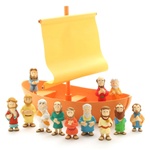
The 12 Apostles!
http://www.bibletoys.com/Figurine-Playsets-s/1.htm


I just saw that these action figures are coming out!
http://www.bibletoys.com/Talking-Toys-s/2.htm


Thursday, August 16, 2012

Our New System that Works for Us


So chaos has a tendency to visit homes of families especially those with small children learning about the rights and wrongs/dos and don'ts of our society. I can't think of any parent who hasn't yet said, "We had a few moments today" or "we had an awful morning today" at some time or another. We had some tantrums this morning actually, venti sized for those of you who speak Starbucks. 

We began using just a sticker chart when Zachary turned 3 to help minimize the frustrations.  This worked well for Zachary because he could earn stickers for positive behavior in about 3-5 different areas.  After he earned 20 stickers he could get a prize from the prize box.  For some kids it may have needed to be less.  If he broke any rules he lost stickers and again we generally focused on about 3 rules at a time which he needed practice on. 

Now that he's aging though we needed something new.  We needed something that would incorporate his chores, his stretches that he has to do for his leg muscles (b/c this is NOT a favorite activity even if we do stretches with him), and also respect which encompasses quite a bit (pushing, tone of voice, yelling, following directions.  This chart idea comes from my mother who has been an elementary teacher for...I think 30 years. Thanks to her we have this new system that works so well for us.  Here is how it works.

Every morning and every afternoon Zachary can earn 3 baseballs so 6 in total each day.  If he does his chores he gets a sticker or a check on the baseball for his "chores" ball, etc. If he chooses not to do them he gets an X on the ball. By the end of the week he has to have 80% of the balls in order to earn his prize.  As time goes on we can increase it to 85%.  Timeouts can still be used at any time we feel necessary as well as taking away privileges.  I give 1 warning for most things before he loses the ball or gets something take except for hitting/being physical.  That's just automatic loss or timeout. Earning stickers on the ball or a check is usually motivating enough for him thus far. 

Some disagree with earning prizes but I do have to argue that everything we do as humans we do for some type of payoff.  Children do not think abstractly or long term the way we do.  They need concrete payoffs and visual aids to help them remember. The payoffs will change as they get older as they learn to appreciate the little rewards of doing things such as enjoying a clean room (hopefully that's one of them).  My hope is always that parents find something healthy that works for their family.  Love to hear about new ideas.


Wednesday, July 11, 2012

Ideas for Family Time


Activities we do as a family listed below

How many times over do you find yourself saying, "my kids are growing up so fast" or "I can't believe my child is already (fill in the blank)?  I look at my kids, excited about watching them grow, yet I just want to stay in some moments forever.  I think about how I always want them to run to me with hugs or be excited to see me after I've been gone or come up to me and say "will you play with me?"  Although every mom needs a break at times, I love being so important to my little ones now.  I almost never (almost) want to be apart from them.  It's nice to be loved.  How can we make this last forever...

My mom and dad are both great examples when it comes to making efforts to stay close to the family.  They both call their parents often.  My mom and her 5 siblings all call each other and seem to feel very comfortable sharing thoughts and feelings with each other.  My dad's family has always lived very near each other.  My husband's family is also a great example.  Every year they gather at the family lake house and do tubing, skiing, cooking, and talking with very little media use. They also eat all the meals together and pray together.  They are so close. Not that either of our families are perfect or don't have issues...but there is definitely a connection.  Now I am trying to do the same for my family.  

We have thousands of responsibilities, interests, goals, and tasks to do in our lifetime.  If anyone reads my Pinterest description they will find that I admit to being interested in having "more hobbies than I can handle".  Fortunately for my family, one of my hobbies IS family itself.  We are all learning how difficult it can be to juggle schedules whether a family is new or old. When we WANT to be close and hang out with each other it's easier to make time since you look forward to it.  So now I'm doing my best to build the bond so we get to that point.

I want my kids to feel like they belong and that they are secure.  I hope that they will feel like they can trust us.  I want them to feel comfortable coming to us when they need to talk.  I want them to know that we love them unconditionally.  So here is to family time and developing strong bonds. 

A great quote from my college priest which is one of my all time favorites- "The most intimate form of community is family" -- Fr. Stephen Payne

So what kinds of things do you like to do with your family? Especially the things that are cheap?


Here is a list of some things that we enjoy doing. 


  1. Family Dinner and telling what we are thankful for
  2. Family game night on Sundays (especially helps when the weekend coming to an end feels like a downer!)
  3. Family music time (dancing, singing or playing instruments)
  4. Family walks or hikes around the city
  5. Picnic lunch
  6. Baking or making new snacks
  7. Playing sports
  8. Gardening
  9. Craft time (whether it's the same craft or we all do different ones. We just walk around Hobby Lobby and get thousands of ideas)
  10. See plays 
  11. Act out stories
  12. Reading a story or chapter book together (maybe add some hot chocolate during the winter)
  13. Go to the library
  14. Family movie night
  15. Camping- (for real, for dinner in the backyard, under the dining room table)
  16. Bowling (Kids bowl free program is available during the summers nationwide)
  17. Family Wii time
  18. House projects (early intervention for young children!)
Here are Things I want to do in the Future
  1. Attend random highschool band, choir, orchestra concerts. Many are probably reasonable or free
  2. Planetarium 
  3. Fruit picking


Tuesday, July 10, 2012

Making Toddler Movie Choices Easy


Movie choice list for my toddler!

A few weeks ago I decided that making this list would be extremely helpful to myself and my daughter. Being a toddler, Adelyn remembers a few shows at a time and forgets about some of her favorite shows, those of which I also really like for her.  This helps her to pick from all of her favorites and also eliminates me having to quickly skip over all of the extra shows on Netflix that are not the most educational or on her level while she is looking with me.  While it can turn into a teachable moment of me explaining to her why we are not watching those shows yet, she enjoys the ease of picking her own show as well with them being in a central location. 

This has "afternoon" on it because shows like Sesame street are easier to play in the afternoon because they are almost an hour long.  In the morning I encourage them to go outside while it is still cool.  Most shows are on both lists though (morning and afternoon). 

I really love several shows on this particular list!

Saturday, January 14, 2012

Teach Me Time Clock

Pinned Image
My son Zachary has always been an early riser.  He's been a pretty consistent 6:30 AM riser since he was a baby and continues to do so at almost 5 yrs.  There were many times when he went through phases of getting up at 6 or even 5:30. Those were not my favorite days.  We decided to enforce a rule saying that he needed to play in his room if he got up before 6:30 until we came to get him. We got him a touch lamp that he could turn on himself. 

After my daughter was born and they started sharing a room when she was 5 months we asked him to play in the game room if he got up too early. Adelyn slept a little bit later than Zachary as a baby and often does currently.  We had issues with him making a lot of noise when he woke up in the morning. Who is surprised?

Daylight savings definitely throws us off for a few days.  Around that time Zachary started doing the 5:45 AM wake time and I decided he really needed to stay in bed longer and at least make more effort to fall back asleep or just rest more.

I received several gift cards to amazon for my birthday and I came across this clock, the Teach Me Time Clock. It was 30 or 40 dollars well invested. I love it! The clock changes color from yellow to green when it's time to get up or get out of bed. Some people online complained that the yellow light at night was too bright for the room but the kids don't have a problem with it. It also has an alarm clock the kids can use when they get older.  

I am very thankful we decided to make this purchase.  We explained to Zachary exactly what time we had the color changer set for and although we do teach him about telling time and clocks, this is also helping him get a feel of time.


Blog Archive